Asteroid Mining // Main Belt
← Return to Main

The Main Belt

Located between the orbits of Mars and Jupiter, roughly 2.2 to 3.2 AU from the Sun, this vast donut-shaped ring contains the majority of the Solar System's asteroids.

While Near-Earth Asteroids are the "quick wins," the Main Belt is the ultimate prize. It contains enough mineral wealth to redefine the global economy and support space colonization for millennia.
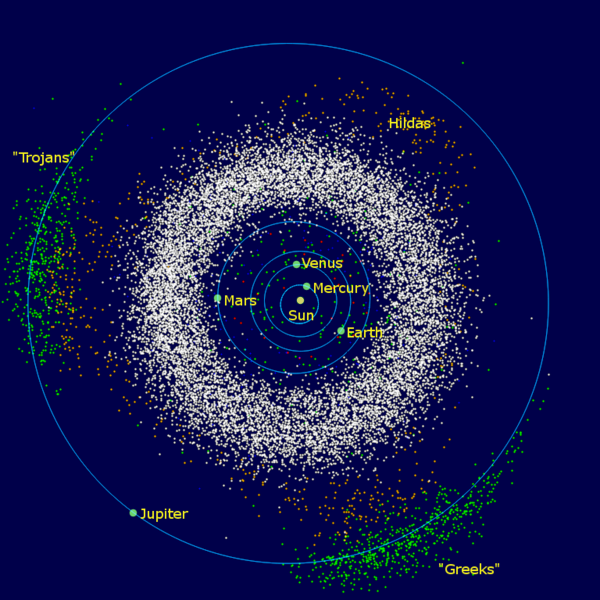
1.9 Million Asteroids > 1km
3 - 6 Years Travel Time
$700 Quintillion Est. Mineral Value

The Big Three

The Main Belt is dominated by massive objects. These are not just rocks; they are potential future colonies and industrial hubs.

C

1 Ceres

The Water Hub

The only Dwarf Planet in the inner solar system. Composed of 25% water ice. It is the likely capital of future belt operations, providing fuel (H2/O2) for the outer system.

P

16 Psyche

The Metal Core

A protoplanetary core exposed by ancient collisions. It is almost entirely Nickel-Iron. A single mission here could retrieve more iron than Earth has ever mined.

V

4 Vesta

The Rocky Outpost

The second most massive body. It has a crust, mantle, and core structure similar to Earth. Rich in basalt and silicates for construction materials.

Logistical Challenges

Why haven't we gone there yet? The Main Belt presents difficulties that NEAs do not.

The Energy Problem

At 3 AU from the Sun, solar panels generate only ~11% of the power they do at Earth. Mining equipment here will likely require Nuclear Power sources (RTGs or small fission reactors) rather than relying solely on solar.

Signal Latency

Radio signals take 15 to 30 minutes to travel one way. Real-time remote control (joysticking) from Earth is impossible. Mining robots must be fully autonomous with advanced AI.